





Asian Carp Threatens the Great Lakes
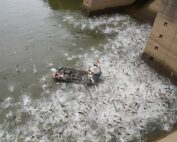
Much attention has recently been focused on the potential spread of two species of Asian carp—bighead and silver—into the Great Lakes from the Mississippi River basin through the Chicago Area Waterway System. Several bills have been introduced in Congress to deal with aspects to improve control of these species. Asian carp, considered an invasive species by the U.S. Department of the Interior and the U.S. Department of Agriculture, are a significant threat to the Great Lakes’ recreational fisheries. Carp populations could expand rapidly and change the composition of the Great Lakes ecosystems, potentially causing significant harm to the $7 billion annual sportfishing economy in the Great Lakes.
On January 19, the U.S. Supreme Court refused to order emergency measures sought by the State of Michigan to close the locks and gates on the Chicago canal in order to block the movement of invasive Asian carp into Lake Michigan. No Asian carp have been found north of an electronic fish barrier in the canal; however, DNA samples taken beyond the barriers have tested positive for Asian carp, indicating that the carp may have already reached Lake Michigan.
On February 8, the governors of the Great Lakes states met with federal officials to discuss strategies to combat the spread of Asian carp in the Great Lakes. The strategy meeting resulted in a $78.5 million plan to further restrict the movement of Asian carp. The efforts include nearly $24 million for construction of two additional electric fish barriers and $5 million for chemical treatments. The plan also calls for researching additional ways to control the expansion of Asian carp, such as sonic barriers, as well as a U.S. Army Corps of Engineers’ study on permanently closing the locks in the Chicago canal.
The American Sportfishing Association (ASA) has for many years been involved in aquatic invasive species issues, including concerns about Asian carp including numerous written and oral communications with the Executive and Legislative branches about the importance of taking specific and timely steps to control Asian carp. In addition to commenting on and supporting various bills in Congress, ASA has worked with the Department of Interior to assure that actions available to the Department are taken in a timely manner. ASA has supported appropriations for the electric barrier on the Chicago Sanitary Canal since it was proposed.
In addition to working with the House of Representatives Natural Resources Committee in 2009 on the basic principles of an invasive species bill draft, ASA has supported bills specific to Asian Carp. On December 3, 2009, before the Senate Committee on the Environment and Public Works’ Subcommittee on Water and Wildlife, ASA spoke in support of legislation to control Asian Carp. ASA also testified specifically on an Asian carp bill before the House Natural Resources Committee in November 2005.
ASA will continue to work with policy makers and its recreational fishing and boating partners and the Great Lakes Fishery Commission to help find ways to appropriately and immediately address this issue.