


Policy Watch

These items cover Government Affairs activities for November and December 2009. For more information on the American Sportfishing Association’s (ASA) Government Affairs activities, contact Gordon Robertson, vice president and Government Affairs lead, x237, Patty Doerr, director, Ocean Resource Policy, x244, or Mike Leonard, Policy fellow, x230. Please visit ASA’s Web site for more information.

ASA Testifies in Support of National Fish Habitat Conservation Act

On December 3, ASA Vice President Gordon Robertson testified before the U.S. Senate Committee on the Environment and Public Works’ Subcommittee on Water and Wildlife in support of S. 1214, the National Fish Habitat Conservation Act (NFHCA). The next week the committee reported out the bill with a substitute amendment that included minor technical changes. The full Senate will vote on the bill at a date to be determined. ASA continues to work with other members of the NFHCA legislative team to encourage House of Representatives members to support the companion bill in the House, H.R. 2565, and to seek additional sponsorship. In December two additional House members signed on to the bill, including the first Republican: Rep. Bill Cassidy (R-La.). To ensure this bill is passed, please send a letter to your House of Representatives member today asking him or her to support the NFHCA. Additional co-sponsors are needed for this bill to succeed. For more information, visit ASAfishing.org. The foundation for the NFHCA is the National Fish Habitat Action Plan (NFHAP); ASA Vice President Gordon Robertson sits on that organization’s board.

California Marine Life Protection Act Planning Update

During its November 10 meeting, California’s South Coast Blue Ribbon Task Force (BRTF), appointed by Gov. Arnold Schwarzenegger, voted to send its own preferred alternative proposal establishing a vast system of marine protected areas along the South Coast to the state’s Fish and Game Commission (FGC). Particularly hard hit will be the Malibu, Orange County and San Diego County fishing communities. The recreational fishing and boating community, represented by the Partnership for Sustainable Oceans, supports Proposal 2, an option drafted in part by recreational and commercial fishermen, that provides additional conservation for California’s ocean resources while minimizing the economic impact of lost recreational fishing and boating opportunities. The BRTF’s preferred alternative joins three other proposals the Regional Stakeholder Group developed that the BRTF voted to forward to the FGC during its October 21, 2009, meeting. The FGC formally received the four proposals during its December 9, 2009 meeting. The commission is responsible for determining which one of the four marine protected area (MPA) proposals the BRTF submitted will be selected for the South Coast. A formal regulatory process to evaluate the impacts of the MPA designations must occur before a final vote can be taken by the FGC, slated sometime late in 2010. The next meeting at California’s Fish and Game Commission is scheduled for February 3–4, 2010, at the Resources Building Auditorium, 1416 Ninth Street, Sacremento. To protect as much recreational fishing opportunity as possible, please send an e-mail to the California Fish and Game Commission in support of Proposal 2 and voice your support for recreational fishing.

Washington State Anglers Face a Ban on Lead Fishing Tackle

During its December 4–5, 2009, meeting in Olympia, Wash., the Washington Fish and Wildlife Commission (WFWC) heard from ASA staff, anglers, recreational fishing organizations and the general public who spoke against a proposal that would unduly ban lead fishing tackle on selected state lakes. Advocates for the proposed ban suggest that lead fishing tackle is a significant threat to common loon populations. During the past 13 years, however, only nine loons died from ingesting it. Many other studies have concluded that lead fishing tackle does not negatively impact loon populations, and that bans on lead fishing tackle are unwarranted. To view ASA’s full written statement, click here. The WFWC will hear additional comments during its January 2010 meeting and make a final decision during a February 2010 meeting. Please take action now to ensure that the WFWC will reject the proposed ban by sending an e-mail or letter to the commission.

South Atlantic Red Snapper Fishery Closed

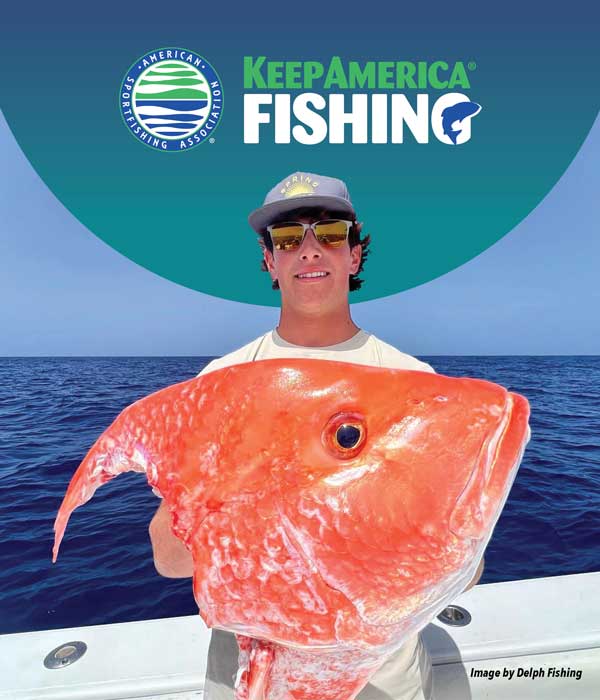
On December 3, the National Oceanic and Atmospheric Administration’s (NOAA) National Marine Fisheries Service (NMFS) announced an interim rule that will prohibit commercial and recreational anglers from fishing for red snapper in federal waters off North Carolina, South Carolina, Georgia and the Atlantic coast of Florida. The six-month closure became effective on January 4, 2010, and can be extended an additional six months if NMFS deems it necessary. The South Atlantic Fishery Management Council requested the fisheries service implement this interim rule while the council explores long-term measures to address the critical condition of red snapper.

Prior to the final announcement, ASA provided comments on the proposed rule expressing its concerns with the proposal, especially given the potential economic impact it would have on the recreational fishing sector and the important role that recreational anglers play in fisheries conservation, and urging NMFS to find a balance between fishing restrictions necessary for the conservation of the fishery and economic impact. ASA continues to address this problem and will soon announce a multi-step campaign that seeks to protect both the fishery resource and recreational fishing opportunity.

Become a KeepAmericaFishing.org Fan on Facebook!

There are more than 500 KeepAmericaFishing fans on Facebook. But with 60 million anglers in the United States, we have a long way to go. Become a fan today and let your friends and family know that they too can be a fan and help keep our nation’s fish and their habitats healthy and accessible now and for the future. You also can sign up for Policy Alerts and other information as well as contribute to the cause at www.keepamericafishing.org.

Government Affairs Committee Meets During Sportfishing Summit

ASA’s 2009 Sportfishing Summit, held October 28-30 at the Rancho Bernardo Inn in San Diego, was attended by more than 130 industry leaders representing 81 companies and organizations from the United States and Canada. Action items from the Government Affairs and board meetings included supporting Congressional restoration of funding for lamprey control programs in Lake Champlain and the Great Lakes. The board also approved ASA’s position statement on aquaculture in the Exclusive Economic Zone. ASA will support California Senate bill SB7X1 to reorganize the governance of water in the state. The board also approved the study of an expanded advocacy effort through KeepAmericaFishing.com. A recap of the 2009 Sportfishing Summit is now available on ASA’s Web site. Please mark your calendars for the 2010 Sportfishing Summit scheduled for October 26-28, at the Westin Beach Resort in Fort Lauderdale, Fla. For more information, contact Mary Jane Williamson, x227, or Ryan Colaianni, x222.

Oregon Marine Reserves Update

ASA and its Oregon representative continue to work with the Oregon Department of Fish and Wildlife (ODFW) officials, state legislators and angler groups to refine the state’s process for establishing marine reserves. Per legislation signed into law this past summer, the state will designate two small marine reserves and study an additional four areas for consideration. ASA is focusing on the four study areas and providing input on the criteria to determine how and if they will become new reserves. ASA’s representative also attended coastal community hearings held to hear input on the draft rules related to the pilot marine reserves at Otter Rock and Redfish Rocks. On December 11, the ODFW adopted regulations that will govern fishing and hunting in Otter Rock Marine Reserve and Redfish Rocks Marine Reserve and Marine Protected Area. To allow time to collect baseline information, the rules will not take effect until June 30, 2011.

ASA Attends Senate Subcommittee Hearing on Ocean Governance

On November 4, ASA staff attended the U.S. Senate Committee on Commerce, Science and Transportation’s Subcommittee on Oceans, Atmosphere, Fisheries and Coast Guard’s hearing to discuss the Interagency Ocean Policy Task Force. At the hearing members of the task force noted recreational anglers’ and boaters’ concerns about being left out of the its Interim Report. ASA and other representatives of the recreational fishing community have held several meetings with Ocean Policy Task Force members since its release on September 17. ASA and other groups explained their concerns with the report, which omitted recreational fishing as a key activity and is biased towards a preservationist policy regarding public waters instead of promoting sustainable uses, such as recreational fishing. For more information on the Ocean Policy Task Force, visit www.keepamericafishing.org/oceantaskforce.html.

Ocean Policy Task Force Releases Marine Spatial Planning Report

President Barack Obama’s Interagency Ocean Policy Task Force recently released its Interim Framework for Effective Coastal and Marine Spatial Planning which offers recommendations for planning and managing uses and activities in the nation’s oceans and coastal areas. This interim framework lays out a process for federal agencies to work with state and local governments and tribes to develop plans on a regional basis over the next five years, with scientific data forming the foundation of the regional plans. President Obama created the Interagency Ocean Policy Task Force on June 12, 2010, which was charged with drafting national ocean policy and developing a framework for marine spatial planning. The task force released its interim report on national ocean policy in September. The interim framework is open for a 60-day public review and comment period.

Gulf of Mexico Red Snapper Recovering

A recent scientific study on Gulf of Mexico red snapper indicated that the current catch level can be increased from five million pounds to slightly more than 6.9 million pounds, though an increase to the total allowable catches (TAC) may not support an increase to the length of the recreational fishing season. TAC is currently split between the recreational (49 percent) and commercial (51 percent) sectors, with the commercial sector operating on an individual fishing quota program. Preliminary data indicate that the recreational fishery, which is managed though size limits, bag limits and seasonal closures, exceeded its annual quota by more than one million pounds in 2009. The scientific update was completed by a panel of experts selected by the Gulf Council and consisting of academic, state and federal scientists. The panel presented its results to the Gulf Council’s Scientific and Statistical Committee in early December. The Gulf Council will review this information at its next meeting in February in Mobile, Ala., and may make a recommendation to National Oceanic and Atmospheric Administration’s (NOAA’s) Fisheries Service to increase the current red snapper total catch level.

Energy and Water Bill Provides Funding for Great Lakes Restoration

On October 28, President Obama signed into law the fiscal 2010 Energy and Water Appropriations bill, legislation that funds essential water projects throughout the United States. The bill includes $2.4 million for the Great Lakes Fishery and Ecosystem Restoration Program (GLFER), a program authorizing the U.S. Army Corps of Engineers to partner with state and local agencies or private groups to implement projects that protect and restore habitat, fisheries and the Great Lakes ecosystem. The Water Resources Development Act of 2000 established GLFER, authorizing $100 million for the U.S. Army Corps of Engineers to partner with state and local agencies and non-governmental organizations to plan, implement and evaluate projects that support the restoration of the Great Lakes fishery and the ecosystem.

EPA Delays Decision on Ethanol Waiver Petition

On December 1, the Environmental Protection Agency (EPA) announced that it would delay a final decision on Growth Energy’s waiver petition to allow ethanol blends up to E15 until more testing data is available. No recreational marine engines, fuel systems or boats are designed, calibrated, certified or warranted to run on any fuel with more than 10 percent ethanol. Allowing higher ethanol blends could pose serious risks to recreational marine engines and boats, including increased air emissions, performance and durability issues, as well as warranty concerns. ASA is opposed to any increase in the amount of ethanol blended into a gasoline until tests are conducted and prove that such an increase would not harm marine engine durability, performance or emissions.

NOAA Releases Draft Catch Share Policy

On December 10, the National Oceanic and Atmospheric Administration (NOAA) released a draft national policy that promotes the use of catch shares for federal fisheries. The proposal encourages regional fishery managers to use catch shares to end overfishing and restore depleted stocks. The proposal also acknowledges that catch shares may not be the best management option for every fishery or sector. The draft policy does not require the use of catch shares in any particular fishery or sector, but promotes and encourages the consideration of catch shares to achieve the goals of sustainable fishery management. To view NOAA’s draft catch share policy, click here or go to www.nmfs.noaa.gov. There is a 120-day public comment period.

Omnibus Bill Regarding Recreational Fishing Data Collection

An omnibus appropriations bill signed by President Obama on December 16, 2009, directs the National Oceanic and Atmospheric Administration’s National Marine Fisheries Service to provide a report to the House and Senate Committees on Appropriations on how data collection for recreational catches will improve in fisheries where the commercial sector receives catch shares and how allocation conflicts between recreational and commercial sectors will be resolved.

Marine Fisheries Advisory Committee Holds Meeting

The Marine Fisheries Advisory Committee (MAFAC) met in November. MAFAC is a federal advisory committee that advises the Secretary of Commerce on all marine resource matters that fall under the jurisdiction of the Department of Commerce. The meeting agenda included discussions on the National Oceanic and Atmospheric Administration (NOAA) Administrator Jane Lubchenco’s recent announcement regarding increased emphasis on recreational fishing, updates on the implementation of the reauthorized Magnuson-Stevens Fishery Conservation and Management Act, and the Interim Report of the Interagency Ocean Policy Task Force. The next meeting will be held in spring 2010. ASA Ocean Resource Policy Director Patty Doerr attended the meeting, which was held in Silver Spring, Md.

ASA Participates in NOAA Stakeholder Workshop

On Dec. 2, ASA participated in the National Oceanic and Atmospheric Administration’s (NOAA) Next Generation Strategic Plan (NGSP) National Stakeholder Forum. The forum’s purpose was to allow stakeholders to provide input on NOAA’s vision, mission, long-term goals and short-term objectives. ASA participated in sessions focused on NOAA’s goals towards sustainable fisheries, habitats and species; and sustainable coastal communities and economies.

Natural Resources Adaptation Bill Introduced

On October 28, the Natural Resources Adaptation Act, S. 1933, was introduced by Senators Jeff Bingaman (D-NM), Max Baucus (D-Mont.) and Sheldon Whitehouse (D-R.I.). The bill would provide for dedicated federal and state natural resource agency funding to plan and implement on-the-ground projects to help fish and wildlife adapt and respond to the impacts of climate change and to foster resilient habitats. The bill, which is similar to the language contained in S. 1733, the Clean Energy Jobs and American Power Act, would require all federal agencies to work together to prepare a national strategy and individual agency plans to reduce the negative impact of climate change on natural resources.

Lake Champlain Receives $6.5 Million for Fisheries Restoration

Congress passed an omnibus appropriations bill that included $6.5 million earmarked for “continued lamprey control, to expand invasive species control, native species and habitat restoration, and water quality improvements in the Lake Champlain Basin.” The item, which was added to the International Fisheries Commission appropriations measure at the request of Sen. Patrick Leahy (D-Vt.), represents more than a fourfold increase over last year’s $1.2 million appropriation for the lake. The bill was signed by President Obama on December 16, 2009.

Cape Hatteras National Seashore Recreation Area Update

Please send a letter to your members of Congress urging them to support legislation that would restore reasonable off-road vehicle (ORV) and pedestrian access to Cape Hatteras National Seashore Recreation Area (CHNSRA). Two bills in Congress, S. 1557 and H.R. 718, would reinstate the Interim Management Strategy finalized by the U.S. National Park Service in 2007 to govern ORV use on CHNSRA until a long-term ORV management plan is completed in 2010. The measure has two Senate sponsors and 10 House of Representatives sponsors. Reinstating the original Interim Management Strategy would set aside the onerous restrictions established by a May 2008 consent decree filed in U.S. District Court. This decree restricts ORV and citizen access to a significant portion of the seashore, including prime surf fishing locations on the East Coast. For more information, visit www.keepamericafishing.org.

December FishNet Meeting

In December, ASA hosted a FishNet meeting to discuss current fishery issues within the fisheries conservation community. Discussion focused on the National Fish Habitat Conservation Act; marine protected areas; Wallop-Breaux reauthorization; the Federal Lands Transactions Facilitation Act; Klamath River dam removal; and an initiative to improve canoe, kayak and fishing access at bridges. The group will meet again in February after federal budgets are released.

Net Operating Loss ‘Carryback’ Signed into Law

On November 6, President Obama signed the Emergency Unemployment Compensation Extension Act, H.R. 3548, which included expanding the net operating loss carryback period from two to five years for losses incurred in 2008 and 2009. Extending the carryback period to five years allows companies to carry back losses to earlier profitable years, since the current two-year allowance is insufficient in the current economic climate. ASA supported these changes and worked through the National Association of Manufacturers on the legislation.

NOAA Habitat Restoration Programs Receive Additional Money

The Commerce, Justice and State appropriations measure, rolled into an omnibus appropriations bill, contained a long-sought and much-needed increase for habitat-restoration programs around the nation’s coastal areas. The increase from $13.5 million to $18.6 million for the National Oceanic and Atmospheric Administration’s community-based Restoration Program represents a several year effort to provide more money for nonprofit organizations, such as ASA’s FishAmerica Foundation. The bill also provided $7 million for removing antiquated dams that impede fish passage through NOAA’s Open Rivers Initiative.

ASA Meets with EPA to Discuss Fisheries Program

In November, ASA, along with representatives from the Association of Fish and Wildlife Agencies and the American Recreation Coalition, met with the U.S. Environmental Protection Agency’s (EPA) Office of Public Outreach and National Fish and Wildlife Program. The groups met to share background information about each organization, discuss EPA Administrator Lisa Jackson’s goals and possible initiatives and discuss how the EPA can work to support healthy fisheries and clean water and the benefits they offer to the nation.

NOAA Environmental Education Bill Approved by House Committee

The House Natural Resources Committee approved a bill formally authorizing two environmental education programs administered by the National Oceanic and Atmospheric Administration. The legislation, H.R. 3644, would expand funding for the Bay-Watershed Education and Training Regional Program (B-WET) and the Environmental Literacy Grant Program. Both initiatives provide grants for education initiatives seeking to connect youth with ocean and coastal ecology. The committee approved an amendment highlighting the value of wildlife-dependent recreation, including recreational fishing, in environmental education programs.

Forest Service Rise to the Future Award Ceremony and Reception

On December 16, ASA staff attended the U.S. Forest Service’s 20th Rise to the Future Awards ceremony. More than a dozen Forest Service staff members, most of whom are engaged in fisheries conservation efforts, were recognized for their exemplary contributions to the Forest Service and its mission.

March 2010 ASA Board of Directors Meeting

The next ASA board of directors meeting will be held March 5, 2010, in Long Beach, Calif., in conjunction with the ASA/Fred Hall Shows. For more information, contact Joyce Anderson Logan, x233.

Petition for Sea Lamprey Control in Lake Champlain

Lake Champlain International is asking anglers to sign a petition for the governor of Vermont to help ensure the continuation of the successful Lake Champlain sea lamprey control program in 2010. Chemical sea lamprey controls are being used by Vermont and New York’s natural resource agencies where the science deems it necessary to control the parasites that threaten the lake’s fisheries resources. The Lake Champlain fisheries contribute approximately $205 million annually to the regional economy and the continuation of the sea lamprey control program is critical to the future sustainability of the Lake Champlain fisheries.