



July 2008 American Sportfishing Association Policy Watch
Policy Watch is a monthly update for the sportfishing community about the American Sportfishing Association’s Government Affairs activities.
For more information on ASA Government Affairs activities, contact Gordon Robertson, vice president and Government Affairs lead, 703.519.9691, x237, Patty Doerr, Ocean Resource Policy director, x244, or Mary Beth Charles, Policy Fellow, x230.
ICAST 2008
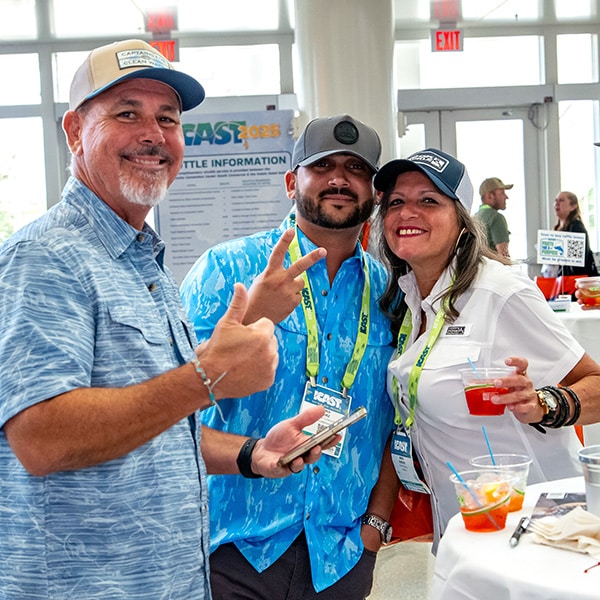
The International Convention of Allied Sportfishing Trades (ICAST) was held July 16-18 at the Las Vegas convention center. ASA presented its members with information about Marine Protected Areas, and other access and fishery issues facing the industry at the Industry Resources Center located on the show floor. ASA was on the show floor with the Recreational Boating and Fishing Foundation and the National Marine Manufacturers Association to discuss many issues with attendees, including access and participation. In addition, a flyer providing information on how to donate to the Keep America Fishing Fund, a fund devoted to ASA’s fight to minimize unnecessary fishing closures, was distributed to all exhibitors.
ICAST Seminars
Two seminars were presented that benefited members. The first was about how to avoid, as best possible, the challenges of product duplication and infringements on patents and copyrights, presented by Marc Gorelnik and Richard Ogawa from Townsend and Townsend and Crew. The second seminar explained how the federal excise tax that manufacturers of sportfishing equipment pay is used to benefit the fishery resource and the industry. This seminar was presented by the Association of Fish and Wildlife Agencies.
Marine Life Protection Act Update (MLPA)
California Marine Life Protection Act (MLPA) proposal 2-XA remains one of four North Central Coast marine protected area (MPA) alternatives in California. The Blue Ribbon Task Force officially submitted the proposal to the Fish and Game Commission (FGC) in early June. The FGC is now planning a series of public meetings starting in October to hear testimony on the four proposals and then vote on the final alternative in the late fall. Proposal 2-XA has the support of ASA and the Partnership for Sustainable Oceans (PSO), as well as other recreational fishing interests. Although each proposal establishes a series of MPAs along the North Central coast as required under the MLPA, the alternative supported by ASA and the PSO has the least economic impact by minimizing unnecessary closures to recreational fishing while placing a high priority on marine resources conservation.
Southern California is preparing for the MLPA process to begin in that region from Point Conception to the Mexican border. In preparation, PSO members have attended SoCal Regional Stakeholder Meetings. ASA and its fellow members of the PSO have submitted nominees to participate in the South Coast Regional Stakeholder Group (RSG). Appointments are expected to be announced in September.
The PSO welcomes the International Game Fish Association as its newest member. They join Coastside Fishing Club, Kayak Fishing Association of California, National Marine Manufacturers Association, Northern California Kayak Anglers, Southern California Marine Association, and Sportfishing Association of California.
Hearing Held on Legislation to Restore Cape Hatteras Access
The Senate National Parks Subcommittee held a hearing July 30 on S. 3113, a bill aimed at restoring reasonable off-road vehicle (ORV) access to Cape Hatteras National Seashore Recreational Area (CHNSRA). Senator Elizabeth Dole (R-NC), testified in support of the bill, on behalf of her constituents who are suffering undue economic hardships as a result of the consent decree. Dare County Commissioner Warren Judge also testified on behalf of the Hatteras community in support of S. 3113. Derb Carter of the Southern Environmental Law Center, the organization that filed the lawsuit on behalf of the Audubon Society and Defenders of Wildlife, testified against S. 3113, saying that the consent decree was working to protect area wildlife. The National Park Service testified that it could not support S. 3113.
Senator Richard Burr (R-NC), Senator Dole (R-NC) and Representative Jones (R-NC) introduced legislation (S. 3113 and H.R. 6233) in June, that would reinstate the Interim Management Strategy finalized by the Park Service in 2007 to govern ORV use on CHNSRA until a long-term ORV management plan is completed in 2010. The reinstatement of the original Interim Management Strategy would set aside the onerous restrictions established by a May consent decree filed in U.S. District Court. This decree severely restricts ORV and citizen access to a significant portion of the seashore, including prime surf fishing locations on the East Coast. ASA supports S. 3113 and H.R. 6233 because the bills will restore reasonable ORV and pedestrian access to CHNSRA while continuing appropriate resource protection. Please send a letter to your Members of Congress urging their support of S. 3113 and H.R. 6233. *Note – This is a call to action for ALL members, not just those from North Carolina. Please show your support for the Hatteras community. For more information, read ASA’s position on S. 3113 and H.R. 6233.
New York Sues Over Flawed Fluke Quotas
The New York State Department of Environmental Conservation (DEC) has sued the U.S. Commerce Department, the National Oceanic and Atmospheric Administration and the National Marine Fisheries Service to overturn fishing restrictions on summer flounder, claiming the agencies used defective information to set New York harvest quotas for the 2008 season. Further, the DEC claims that because of flaws in the quota system, New York arbitrarily has a disproportionate burden of the federal plan for summer flounder recovery. The lawsuit asks the court to throw out the 2008 summer flounder quotas and direct federal agencies to impose uniform, coast-wide limits for summer flounder harvest.
Clean Boating Act of 2008
The Senate and House passed the Clean Boating Act of 2008, introduced by Senators Bill Nelson (D-FL) and Barbara Boxer (D-CA) and Representatives Steve LaTourette (R-OH) and Candice Miller (R-MI). The Clean Boating Act fully and permanently restores a permit exemption for recreational boat’s non-polluting incidental discharges. The President signed the bill into law July 29 aboard Air Force One, just two days before the EPA public comment period closed on their proposal for the new permitting scheme. Passed at the same time were separate commercial vessel bills, which provide a temporary moratorium from permitting for certain commercial vessels.
ASA Attains Fish Passage Provisions in HR 1195
The president signed into law Transportation Bill funding for fish passage construction on National Forest System roads. HR 1195, sponsored by Congressman James Oberstar (D–MN), was passed by the House in April. The bill allocates $10,000,000 annually for fish passage throughout the entire National Forest System. Fish passage was identified in a General Accounting Office report as a critical need in the National Forests.
Opportunity to Participate in Federal Excise Tax Conservation Programs
Ever wondered how your excise tax monies are being used for fisheries conservation? The U.S. Fish and Wildlife Service (USFWS) and the Association of Fish and Wildlife Agencies (AFWA) are inviting ASA members to participate in reviews of programs and projects completed by state fisheries agencies using these funds. Reviews may include behind the scenes tours of hatcheries, research projects and fisheries monitoring programs. If you are interested in this effort and would like to either participate in these reviews or would simply like to receive more information on any state’s Sport Fish Restoration program projects, contact Brian Bohnsack, Association of Fish and Wildlife Agencies, (202) 624-5363.
Presidential Proclamation Creating New MPAs Remains Uncertain
On at least three occasions in July, ASA communicated with key White House and other executive branch staff, requesting that the interests of recreational angling be protected in any marine protected area (MPA) designations, including the suggestion to have the President issue a policy statement on MPAs that includes a declaration that sport fishing be protected in perpetuity as a legitimate sustainable activity, subject to science based management.
ASA Attends Senate Leadership Meeting
ASA, along with other fishery and wildlife conservation groups, attended a Senate majority leadership meeting. The purpose was for the groups attending to provide comments to Senate leadership and staff about key areas of concern. ASA provided comments on anglers access, marine protected areas, fish habitat legislation and the reauthorization of the Sport Fish and Boating Trust Fund.
Meeting With Oceans Bill Sponsor
ASA, the Coastal Conservation Association and the National Marine Manufacturers Association attended a meeting with Representative Sam Farr (D-CA), a sponsor of H.R. 21, a major oceans management bill. Each of the organizations expressed their concern about the bill as it relates to recreational fishing and boating and indicated willingness to work with Congressman Farr on improvements to H.R. 21 to address the concerns of the sportfishing industry.
Center for Coastal Conservation Officially Launched
The Center for Coastal Conservation, a non-partisan national organization dedicated to enacting marine conservation laws through education and political action, was officially launched at ICAST 2008. Jeff Angers, formerly the executive director and CEO of the Coastal Conservation Association of Louisiana, is the Center’s first president. For more information, contact CCC at (225) 382-3755.
Massachusetts Lead Sinker Bill Fails to Pass Before End of Session
A bill that would restrict lead sinker and lead jig use in Massachusetts failed to pass before the legislature adjourned. ASA had monitored the bill and provided comment to state officials on the impacts of the proposal. ASA wishes to thank the several ASA Massachusetts members who responded to our request to write their legislative representatives in the Bay State. The measure still has some life because in Massachusetts, a bill that has passed one chamber and is pending in another may be taken up at summer interim legislative sessions and passed under unanimous consent. The bill could pass if brought up and no member present objects. ASA will continue to work with legislators and agency staff on this matter.