



May 2006 American Sportfishing Association Policy Watch
Policy Watch is a monthly update for the sportfishing community about
American Sportfishing Association’s Government Affairs activities.
For more information on ASA Government Affairs activities, contact Gordon
Robertson, VP and Government Affairs lead, x237 or Carol
Forthman, director, Ocean Resource Policy, x244 at 703.519.9691.
House Resources Committee Passes Magnuson-Stevens Reauthorization Bill
The House Resources Committee passed H.R. 5018 on May 17, 2006. The bill, sponsored
by Representative Richard Pombo (R-CA), is the reauthorization legislation for
the Magnuson-Stevens Fishery Conservation and Management Act. The bill's provisions
are similar to those passed in the Senate Commerce Committee in December. Important
differences to recreational anglers in the House bill include the absence of
any licensing or registration provision and the inclusion of more flexible requirements
on total allowable catch and rebuilding issues. Both the House bill and the Senate
bill provide guidelines for no-fishing areas and consideration of economic impact
in allocation.
TRCP Media Conference Gets Out the Word on Magnuson-Stevens
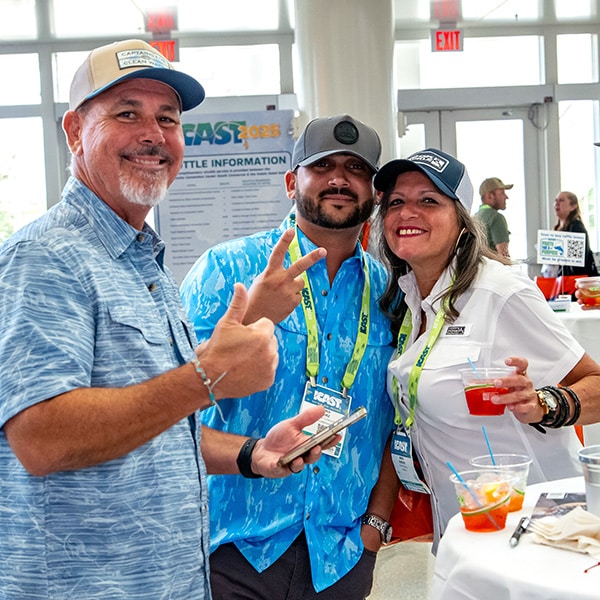
In April, ASA staff attended a conference hosted by the Teddy Roosevelt Conservation
Partnership (TCRP) held in Florida for its partners and media representatives
from throughout the U.S. During a briefing for media participants, ASA provided
the industry’s perspective on the Magnuson-Stevens Reauthorization Bill.
ASA Participates in Southeast Bycatch Workshop
In May, the National Marine Fisheries Service Southeast Regional office sponsored
a workshop on bycatch with a diverse audience in attendance. Carol Forthman,
ASA's Ocean Resource Policy director, gave a presentation on recreational bycatch
issues, focusing on catch and release and participated in working group discussions.
ASA Seeks Long Term Solutions for Northwest Salmon
In May, at the request of Representative Mike Thompson (D-CA), ASA and two
other fishery groups met with the Congressman to discuss long-term solutions
for western salmon issues.
ASA Presents at Clean Water Agencies Convention
In May, ASA gave a presentation on the effect of non-point pollution on fisheries
and discussed the approach taken by Florida in addressing agricultural runoff
in the Suwannee River Basin during the National Association of Clean Water Agencies
convention in Washington, D.C.
ASA Participates in Review of Supreme Court Wetlands Cases
Two important wetlands cases are now being considered by the Supreme Court. ASA
is amicus curiae (a group not party to the legislation,
but who believes the court’s decision may affect its interests) on the
briefs before the Supreme Court. In April, the Association of State Wetland Managers,
Ducks Unlimited and the National Wildlife Federation sponsored a meeting to review
the background of the cases and consider possible responses to a decision. ASA
participated in the discussions and review of these cases.
Michigan Introduces Lead Sinker Legislation
House bill No. 5575 would ban the sale of any “lead fishing tackle,” beginning
January 1, 2007, which is defined by the bill as any of the following:
- A sinker that contains 1 ounce or less of lead or a lead compound;
- A jig that contains lead or a lead compound;
- An item of fishing tackle other than a jig or sinker that contains
any lead or lead compound.
The measure is not expected to advance and is not supported by the state
fish and wildlife agency or statewide sportsmen groups. It has been
referred to the House Committee on Natural Resources, Great Lakes, Land
Use and the Environment.
Canadian Lead Sinker Proposal discussed at Symposium
Last fall, a Symposium was held in Canada to address the lead sinker issue. The
event provided a forum for scientific researchers and other professionals to
present and discuss findings on the aquatic impacts of lead fishing tackle. A
formal report of the Symposium is being prepared for Canada’s Minister
of Environment. At the Symposium many of the presenters expressed support for
the voluntary transition to lead-free terminal tackle. Canada’s recent
federal election has put this issue temporarily “on hold” at the
Ministerial level. ASA and the Canadian Sportfishing Industry Association have
worked together on this issue, and both organizations’ position remains
that regulation is unnecessary, unenforceable and would set a serious precedent
for future issues in the sportfishing industry.
EU Lead Sinker Ban Withdrawn
In May, the European Union (EU) confirmed it will not propose a lead ban on fishing
sinkers and other fishing equipment containing lead. This conclusion was reached
following findings in a 216 page report/study on the advantages and drawbacks
of lead used in various sporting equipment, leisure products and candle wicks
and their overall affect on the environment. Currently Denmark is the only country
with a general ban on the use of lead for fishing sinkers. The United Kingdom
imposes a ban on sinkers below one ounce in fresh water. In Sweden, there
are voluntary local guidelines on the use of lead sinkers in certain rivers.
EU Proposal to Resume Tackle Sanctions Avoided By Congressional Action
In May, the European Union (EU) announced that it would resume sanctions, at
a 14-percent level, on U.S. imports, including numerous items of fishing tackle,
picking up where the previous actions terminated. With unprecedented speed, the
U.S. Congress passed legislation satisfying the World Trade Organization and
EU concerns on the same day, and the measure was signed by President Bush on
May 17, resulting in a repeal of the proposed new sanctions.
ASA Supports Hard Rock Mining Clean-Up
ASA attended a briefing by Environmental Protection Agency Administrator Stephen
L. Johnson to discuss the Administration’s “Good Samaritan” legislation;
a bill to clean-up abandoned hard-rock mining sites.
ASA Asks IRS to Provide Directive
Since the meeting with the Internal Revenue Service (IRS) on January 31,
2006, the sportfishing industry has been awaiting an IRS Industry Director’s
Directive. This Directive would explain and provide guidelines
on how the IRS views tax payer responsibilities for the federal manufacturers’ excise
tax that all sportfishing manufacturers must pay. On May 24, 2006,
ASA sent a letter to the IRS’s Director of Specialty Taxes requesting
they provide this information so the sportfishing industry can plan pricing
and know how and at what point excise taxes must be paid.
In February
2006, ASA wrote a letter requesting that any changes in compliance
application become effective at a future date, allowing the industry to
plan for these changes. The IRS has not responded to that request.